Showing posts with label Anti-Stigma. Show all posts

Tuesday, October 24, 2017

What Do I Mean When I Say I'm Fine?

Living with a chronic condition, such as multiple sclerosis, brings with it a heavy load of emotional, physical, and social challenges. The symptoms alone can be perplexing and are never the same between two people. Lately, there’s one social challenge that has been on my mind—how to respond to the question, “How are you?”
When in a group setting, I almost always respond with “I’m fine,” or “I’m good,” without thinking about it. An upbeat “I’m fine” is automatic. When in a one-on-one setting, I may pause and consider how exactly I want the conversation to go. If I’m with a very close friend, I might expand my response and go into more detail, regardless if the update skews positive or negative.
When talking to my husband, I want to be honest but I also know how much he wants me to feel well. Depending upon what type of support I need at the moment, I might allow my empathy for his feelings to color my response. I don’t like to feel as though I am dumping all my crap on him. But when I need extra support or understanding, I feel safe in sharing what’s really going on and how I feel about it. When I tell my husband “I’m good,” it generally means I feel confident that I can manage things at the moment.
Earlier this summer, I was experiencing increased pain due to knee osteoarthritis and was seeking care from my orthopedic doctor who prescribed a series of injections. My mother-in-law has had her own knee problems, so she felt sympathy for what I was going through. I visited her following one of my knee injections and she asked how I was. My response was a neutral “I’m okay.” Her brow furrowed and she replied, “Not good, then?” “No, I’m doing fine,” I insisted. Her experience colored how she heard my simple words.

Read this post in its entirety:
The Many Shades of I'm Fine

Friday, March 10, 2017

Don't Cross The Line: Accessible Parking and Common Courtesy


According to the ADA National Network, the minimum width of accessible spaces is 8 feet, while van-accessible spaces should be 11-feet-wide. Access aisles are 5-feet-wide and can be shared between two spaces to provide extra room for the deployment of vehicle-mounted wheelchair lifts or the unloading of wheelchairs, walkers, or other mobility devices. An alternate design allows a van-accessible space to be 8-feet-wide IF the adjacent access aisle is also 8-feet-wide.

Do NOT park on the hatch marks

Karen, a friend of mine who uses a motorized wheelchair, drives an accessible van. With a push on her key fob, the side door of her van opens, and a metal ramp unfolds. To maneuver in and out of her van, she needs the extra “hatch space” to use the ramp. Too often she will carefully park within the boundaries of a van-accessible parking space to later return and find that someone else has carelessly parked in the access aisle.

When this happens Karen has limited actions. She can go into the nearest business and try to find the driver of the offending vehicle and ask him/her to kindly move their car. She can call the police to help her move her van to an area with enough room that she can safely access the ramp. Or, if she is not alone, she can rely upon a friend to move her van. That’s what happened when we recently met for dinner at a local restaurant. Someone had parked over the hatch marks, which prevented her from being able to maneuver onto her ramp to get in her van. It was very frustrating, but I’m glad that we were nearby to help.

Read this post in its entirety:
How NOT to Park in the Handicapped Space

Wednesday, March 8, 2017

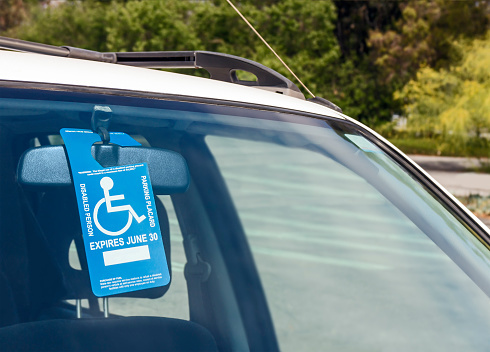
When To Get A Disabled Parking Placard


Handicapped parking is one of the more controversial issues in the multiple sclerosis (MS) community. Many people have mixed feelings about the need to park in designated parking spaces that offer some level of increased access to public and private facilities. The social stigma and lack of understanding from others can make the decision to obtain a disabled parking permit a difficult one.

While I’ve never been subject to insensitive comments — “but you don’t LOOK disabled” or “you really shouldn’t be parking there” — I do remember considering whether getting a permit might be a good idea or not. I had only been diagnosed with MS for about one year and was managing my limitations well, but I knew that it would be easier to get around if I had one.

Read this post in its entirety:
Why Should You Get a Disabled Parking Placard?

Tuesday, June 17, 2014

Living with MS and Social Stigmas

Social stigmas are an unfortunate part of our society.  A social stigma is the extreme disapproval of a person or group of people based on a perception that something sets them apart from what is ‘normal’ or socially acceptable.  Social stigmas exist around mental illness, physical disability, disease, race, education, religion, ideology, and more.
Removing the stigma of MS.

One theory behind the many efforts to raise awareness of multiple sclerosis is to begin to remove the stigma of MS.  By educating people about the disease, we (those affected by MS) hopefully can show how our differences caused by MS do not make us so different after all.  In concert with that, increased awareness and knowledge may help others to recognize that our differences, whether visible or invisible, do set us apart from the average person and necessitate special considerations.

“I’m not drunk; I just have MS.”

This phrase is commonly used by people with MS to laugh at the effects of the disease.  But it also seems to establish that there is an unspoken hierarchy amongst stigmas.  Apparently walking around in an uncontrolled drunken manner (or stumbling while hammered off your ass, so to speak) is less acceptable than walking on the wobbly legs of someone who has impaired balance, coordination, or strength.  In essence, the phrase is emphasizing that ‘I’d rather be perceived as physically disabled, than as someone who doesn’t know when to stop chugging alcohol.’

“I’m not stupid; I just have cognitive information processing difficulties due to MS.”

Read this post in its entirety:

Living with MS: Overcoming Self-imposed Stigma